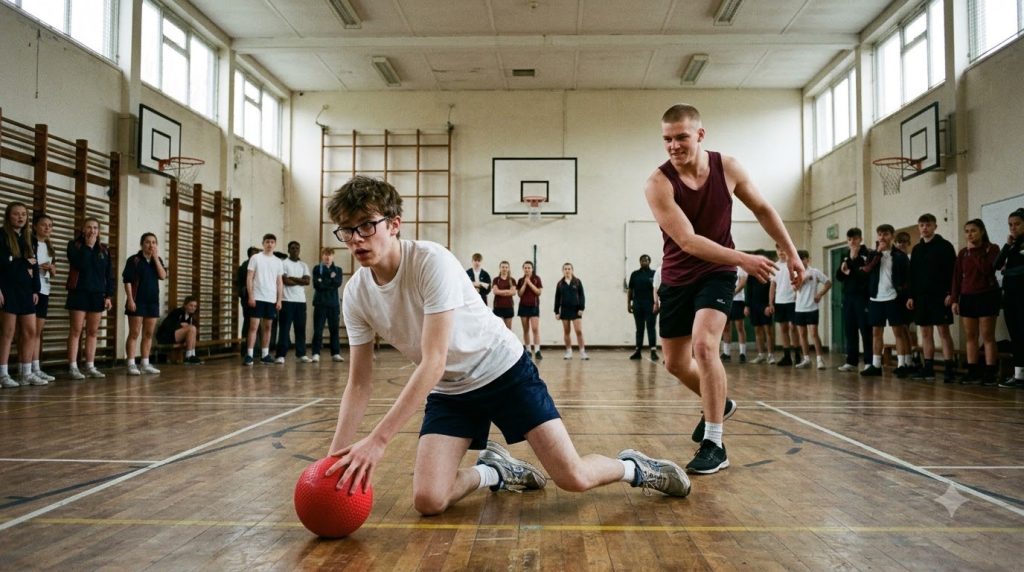
If he stopped now, the situation could still be handled without anyone getting seriously hurt.
I wanted him to make that decision.
But Bryce seemed unable to see a way out that did not require me to surrender first.
His pride had become more important than his judgment.
He looked at my glasses.
Then at my face.
Then at the students watching from the sidelines.
I could see the anger returning.
He moved toward me again.
This time, I did not have to guess whether he intended another confrontation.
His posture made it clear.
He was coming straight toward me.
I tightened my grip on the damaged frames.
I wanted to put them somewhere safe, but I did not have time.
I placed them down near the dodgeball and moved my hands away.
I was preparing to step back when the equipment room door opened.
The sound was sharp in the quiet gym.
Our teacher emerged.
He had been carrying supplies, but his attention shifted toward the court as soon as he saw Bryce moving toward me.
His expression changed immediately.
“BRYCE!
STOP!”
The command echoed across the room.
Bryce froze.
For the first time that afternoon, he obeyed someone without arguing.
His shoulders remained tense, and his face was still flushed, but he stopped advancing.
I felt the relief before I fully understood it.
The teacher was back.
There was finally an adult standing between the incident and whatever might have happened next.
I took another step away.
My legs felt strangely unsteady.
I had remained balanced during the confrontation, but now that the immediate danger seemed to be passing, my body was beginning to react to the stress.
My hands trembled slightly.
I curled my fingers once, then opened them again.
I looked at the teacher.
He was scanning the court.
The students.
Bryce.
Me.
The padded area.
The scattered equipment.
I could almost see the questions forming in his mind.
He had left a class that was supposed to be finishing an ordinary game.
He had returned to find two students facing each other in the middle of a silent gym, one furious and the other standing near a broken pair of glasses.
It would have been easy for him to misunderstand the situation.
And Bryce moved quickly to make sure he heard one version first.
“HE THREW ME DOWN!”
Bryce pointed at me.
His voice was loud and indignant.
I felt my stomach tighten.
There it was.
The part I had feared all semester.
The moment when Bryce attempted to turn the consequences of his own behavior into evidence that someone else had done something wrong.
Advertisement
Hotel advertisement 4
I looked at the teacher.
I wanted to explain.
I wanted to tell him about the dodgeball hitting my face after the game had ended.
About the second ball striking my shoulder.
About Bryce shouting at me.
About the shove.
About the swing.
About the charge toward the padded area.
But the entire sequence suddenly seemed difficult to organize.
How could I explain so many decisions in a few sentences?
How could I make the teacher understand that I had spent the entire confrontation trying not to fight?
And how could I do that without sounding as though I was simply accusing another student?
Bryce was already talking.
His words came quickly, supported by angry gestures.
He pointed at the mat.
Then at me.
Then back at the mat.
He wanted the teacher to focus on the fall.
Nothing before it.
Nothing that explained why it had happened.
Just the final image of the strongest boy in class lying on the padded floor.
I recognized the tactic because I had seen smaller versions of it before.
A joke was only a joke until somebody objected.
Then the objection became the problem.
A deliberate provocation disappeared from the story, leaving only the reaction.
That was what Bryce seemed to be trying to accomplish.
I almost interrupted.
But the teacher raised a hand.
He was not smiling.
He did not look entertained.
And, importantly, he was not immediately agreeing with Bryce.
He looked at both of us.
Then he looked across the students standing near the edge of the court.
Nobody laughed.
Nobody made another joke.
The teacher’s eyes moved slowly over the room.
I wondered what he was noticing.
Perhaps the silence.
Perhaps the way several students were holding their phones.
Perhaps the fact that nobody seemed surprised to see Bryce behaving angrily toward me.
I could not know.
Then his gaze dropped toward the floor.
He noticed the dodgeball.
Beside it lay my damaged glasses.
The teacher looked at them for several seconds.
Then he looked at my face.
I knew the red mark was still visible on my cheek.
He studied my expression.



