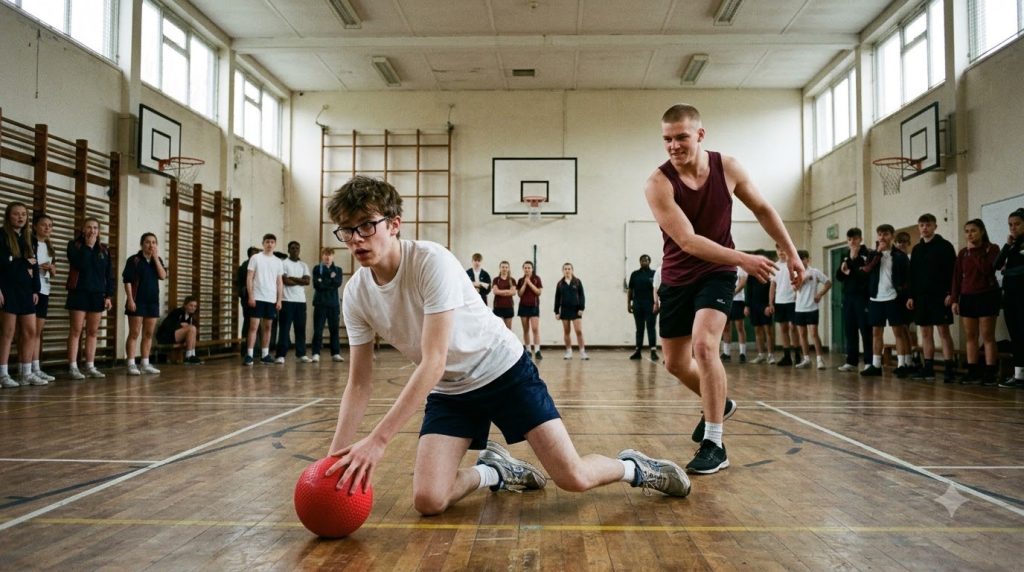
I was afraid of what Bryce might do.
Anyone in my position would have had reason to be.
He was stronger, angrier, and standing close enough to touch me.
But fear did not require me to abandon my judgment.
I could be frightened and still think clearly.
I could want the confrontation to end without agreeing that I deserved it.
I could recognize the danger without pretending the danger was my responsibility.
Those distinctions mattered more to me than looking brave.
I kept my hands open.
I did not make fists.
I did not raise my arms as though preparing to strike him.
I did not want anyone watching to misunderstand my intention.
I wanted distance.
I wanted the teacher to return.
I wanted the other students to understand that I was not participating in another round of dodgeball or a new competition.
The activity was over.
That should have been enough.
Bryce leaned forward slightly.
He seemed irritated by my silence.
I looked past his shoulder.
A student standing near the wall was no longer smiling.
Another had lowered his arms and was watching with an expression I could not quite read.
The mood of the room was changing.
There had been a time when Bryce could make everyone laugh simply by pointing at me.
Now he had to work harder.
He was no longer mocking a bad throw or a missed catch.
He was confronting a student who had asked to be left alone.
The difference was becoming visible.
I wondered whether he noticed.
If he did, he seemed to resent it.
He glanced briefly toward the watching students, then returned his attention to me.
His jaw tightened again.
He took another step forward.
I shifted my weight, preparing to move away if he entered my space.
The movement was small.
Bryce noticed it.
His expression changed as though he had caught me doing something embarrassing.
I knew what he thought.
He thought I was backing down.
But I was not thinking about pride.
I was thinking about balance and distance.
I wanted enough space between us that he would have to make an obvious choice to continue.
I had no interest in accidentally brushing against him and giving him an excuse to claim that I started something.
Every inch mattered now.
That was how close we had come to a situation that could no longer be dismissed as a joke.
The longer Bryce stood in front of me, the more I became aware of the room around us.
The basketball hoops hung above the far ends of the court.
The red dodgeball rested near the painted boundary line.
My glasses were still lying where they had fallen.
Students had formed a loose arc around us without anyone telling them to.
No one had planned that arrangement.
People had simply stepped away from the space where Bryce was moving.
The result left us exposed in the center.
I did not like it.
I had never liked crowds watching me.
There was something especially uncomfortable about knowing that people were waiting for a decision they would not have to make themselves.
If I apologized, they would see it.
If I argued, they would hear it.
If Bryce pushed me and I lost my balance, they would remember it.
And because everyone had a different idea of what counted as courage, almost any response could be criticized.
Some people thought you were weak if you refused to fight.
Others thought you were reckless if you defended yourself.
Some expected you to tell a teacher.
Others treated that as an admission that you could not manage your own problems.
It was impossible to satisfy all of them.
The only thing I could control was my own behavior.
That thought helped me focus.
I stopped worrying about the students as an audience.
I began thinking of them as witnesses.
People who could see the same court, the same ball, the same student moving toward me after I had clearly stopped participating.
I hoped someone would be willing to describe what happened.
But I understood that I could not depend on that hope.
I had to make my own decisions in the moment.
Bryce was still standing too close.
I could feel my muscles tightening with the effort not to react prematurely.
The temptation to push him away was strong.
Not because I wanted to hurt him.
Because I wanted to reclaim the space he had taken.
But I knew how easily that could change the story.
If I placed my hands on him first, even to move him back, someone might remember only that I had pushed him.
If I shouted, someone might remember us both yelling.
If I threw the ball, the earlier headshot might become part of a mutual argument rather than the reason I was upset.



