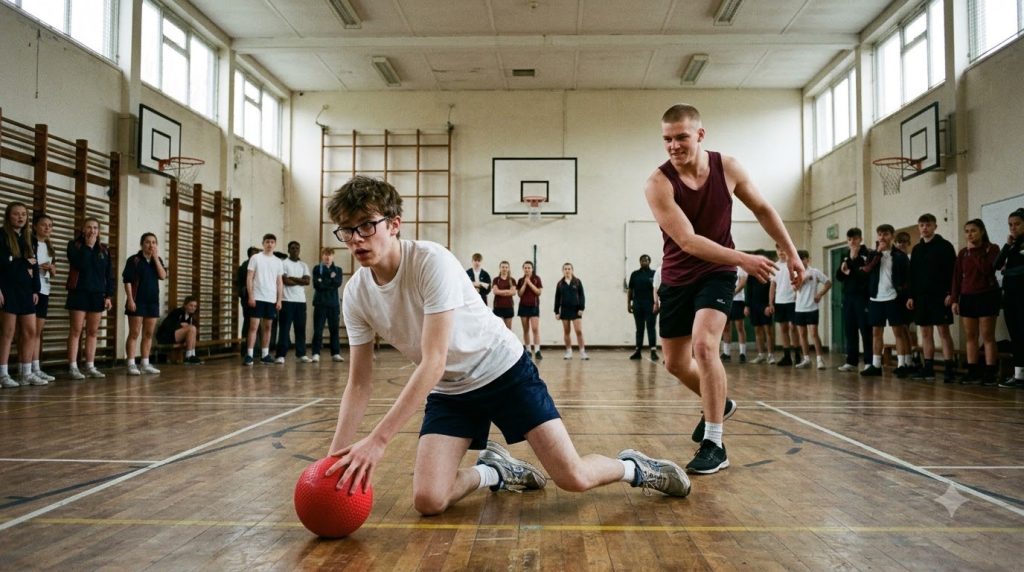
He was watching me closely, perhaps searching for the nervous expression he had seen so many times before.
I knew what he expected.
An apology.
An explanation.
A frightened smile.
Anything that would place him back in control.
Instead, I looked toward the equipment room.
The door remained closed.
I could hear movement somewhere behind it, the faint sound of metal being handled.
Our teacher was nearby.
That knowledge was reassuring.
It was also frustrating.
A few yards and one closed door separated an adult with authority from twenty students witnessing something that should not have been happening.
I wondered whether anyone had gone to get him.
I could not see anyone moving toward the room.
The students stayed where they were.
Some watched Bryce.
Some watched me.
I noticed a phone in one student’s hand.
Then another.
Phones were common in our school, and seeing one did not automatically mean anything.
But the way the students were holding them was different now.
They were not casually checking messages.
They were looking over the tops of their screens.
I felt a sudden discomfort at the thought of being recorded.
I did not want a video of myself standing in the middle of a gym with a red mark on my face and my glasses on the floor.
I did not want strangers deciding whether I had looked brave or frightened.
I did not want the next morning to begin with classmates discussing an incident I was still trying to survive.
And yet part of me understood why someone might record what was happening.
There had been so many moments when Bryce acted as though events could be rewritten afterward.
So many times when a deliberate insult became a harmless joke.
So many times when a student who objected was accused of taking a game too seriously.
I remembered that habit now.
If something happened, I wanted the truth to remain recognizable.
Not because I expected anyone to celebrate me.
Because I was tired of explaining that something had happened exactly the way I remembered it.
There had been one afternoon earlier in the semester when Bryce had mocked the way I ran.
We had been finishing a simple exercise.
I was breathing hard, but I had completed what the teacher asked us to do.
Bryce was standing with several students when I passed.
He glanced at me and made a comment about how little effort it would take to knock me over.
The others laughed.
I kept walking.
For the rest of that period, I could hear the comment replaying in my thoughts.
It was not because I believed him.
It was because I did not understand why he needed to say it.
I had not challenged him.
I had not insulted him.
I had not even spoken to him.
I was simply another student completing the same activity.
That was what made his behavior so difficult to anticipate.
I could understand an argument that began with a disagreement.
I could understand someone becoming upset after being treated unfairly.
But Bryce often seemed to begin with the desire to make another person uncomfortable.
Then he searched for a reason afterward.
Sometimes he did not even bother searching.
The laugh was reason enough.
After that earlier class, I had wondered what would happen if I finally answered him.
I could imagine the conversation.
I could imagine saying that I was tired of his comments.
And I could imagine him standing up straighter, raising his voice, and demanding to know what I intended to do about it.
In those imagined conversations, I always got stuck at the same place.
I wanted him to stop.
He wanted me to react.
Those were two completely different goals.
That realization had shaped the way I dealt with him.
I stopped trying to win arguments that I had never wanted to begin.
I refused invitations to insult him back.
I concentrated on staying away from situations where he could turn an audience against me.
Most days, that approach kept things manageable.
But it also meant Bryce had never heard me speak firmly to him.
The afternoon of the dodgeball game was different.
He had finally heard a refusal that did not come wrapped in nervous laughter.
And he seemed unable to accept it.
“Say something,” Bryce demanded.
I looked at him.
There was nothing useful I could say that I had not already said.
My cheek was beginning to throb.
My shoulder felt sore where the second ball had struck.
The gym floor was cool beneath the thin soles of my shoes.
I was aware of all three sensations with surprising clarity.
I could also hear my breathing.
It was steady, though my heart was beating faster than I wanted.
I was not calm in the sense of feeling no fear.



