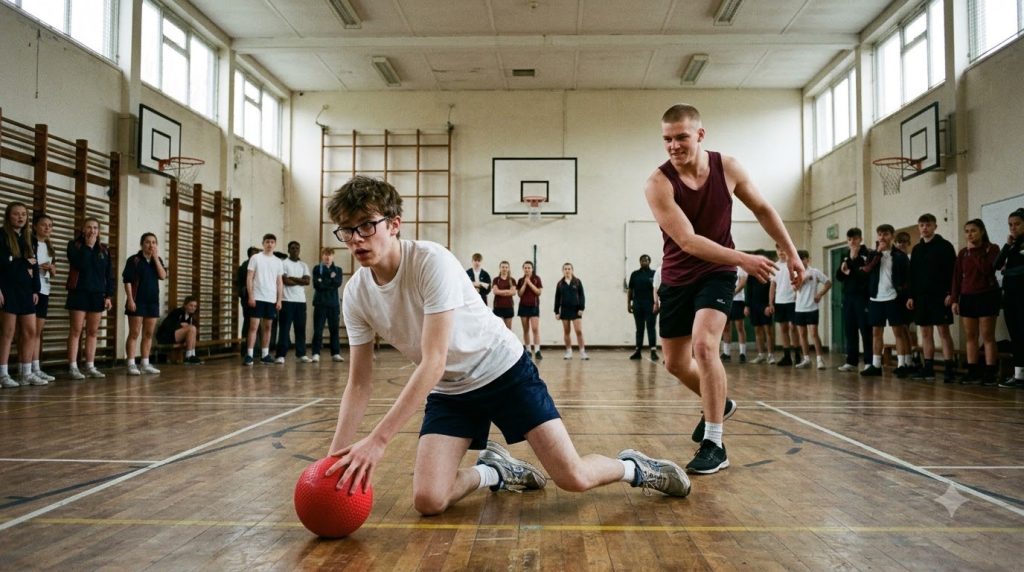
If I became angry and threw wildly, he could laugh at my lack of skill.
If I complained, he could call me sensitive.
If I cried, he would have exactly the kind of victory he had been hoping for.
And if I did nothing, he would continue believing he could choose how I spent every minute of gym class.
I thought about all the times I had told myself to ignore him.
All the moments when I had let a comment pass.
All the times I had stepped away rather than turn a small insult into a public confrontation.
I still believed those decisions had been reasonable.
I did not regret trying to avoid trouble.
But I had reached a point where silence no longer seemed likely to end it.
Not because I suddenly wanted revenge.
Not because I wanted to prove that I was stronger.
Because the game was over.
And he would not stop.
I picked up the dodgeball.
Its surface felt warm and slightly rough against my palms.
For an instant, the gym seemed to become quieter.
Not silent.
There were still students moving near the walls.
A ball was still rolling somewhere behind me.
Someone was whispering.
But the attention in the room had shifted.
I had done something Bryce wanted.
I had picked up the ball.
He must have thought I was finally going to throw it back.
His grin widened.
He bent his knees slightly, ready to move.
I could see the challenge in his posture even without my glasses.
He wanted me to make the attempt.
He wanted another chance to embarrass me.
For the first time that afternoon, I looked directly at him.
I did not raise the ball.
I did not move toward him.
I simply held it in front of me.
And I said two words.
“You’re done.”
Bryce’s smile changed.
It did not disappear.
It sharpened.
“Or what?”
The question carried across the gym.
Somebody laughed uncertainly.
Bryce spread his arms, inviting an answer.
I looked down at the ball.
It would have been easy to throw it.
That was what everyone seemed to be waiting for.
One quick movement, one hard release, one attempt to strike him the way he had struck me.
Advertisement
Hotel advertisement 7
But I knew what would happen if I accepted his challenge.
He was bigger.
He was stronger.
He enjoyed confrontation.
And if I threw the ball, the argument about whether the game had ended would suddenly become an argument about why I had thrown something at another student.
I did not want to give him that.
I lowered the dodgeball.
It touched the floor beside my foot.
Then I straightened.
“I’m not playing this game with you.”
The words were simple.
I had not planned them.
But once I said them, they felt more honest than anything else I could have offered.
I was not going to throw a ball at him.
I was not going to compete for the amusement of the class.
I was not going to keep pretending that the game rules gave him permission to do whatever he wanted.
I had made my decision.
Bryce stared at me.
For a second, I thought he might laugh again.
He had laughed after every other insult.
He had laughed when I missed catches.
He had laughed when I stayed quiet.
He had laughed when the ball hit my face.
But now there was something different in his expression.
His jaw tightened.
His shoulders lifted.
The smile began to disappear.
I could see him processing what I had said.
And I realized that I had done something more upsetting to him than throwing the ball ever could have been.
I had refused to participate in the scene he had created.
One of the hardest things about being bullied is that other people sometimes begin to believe the bully understands you better than you understand yourself.
If someone calls you weak often enough, the word starts appearing in conversations where you are not even present.
A missed catch becomes proof.
A quiet answer becomes proof.
A decision not to argue becomes proof.
Eventually, the person making the accusation no longer feels the need to demonstrate it.
He simply points at you, and everyone already knows the story.
That was what had happened with Bryce.
He had created an explanation for me.
I was the skinny boy who never fought back.
The boy with glasses who was afraid of getting hurt.
The boy who could be embarrassed without consequences.
It did not matter that he knew almost nothing about me outside gym class.
He knew which version of me made people laugh.
And that was the version he kept presenting.
I had begun to wonder whether anyone in the room remembered that I was a person who existed beyond his jokes.



