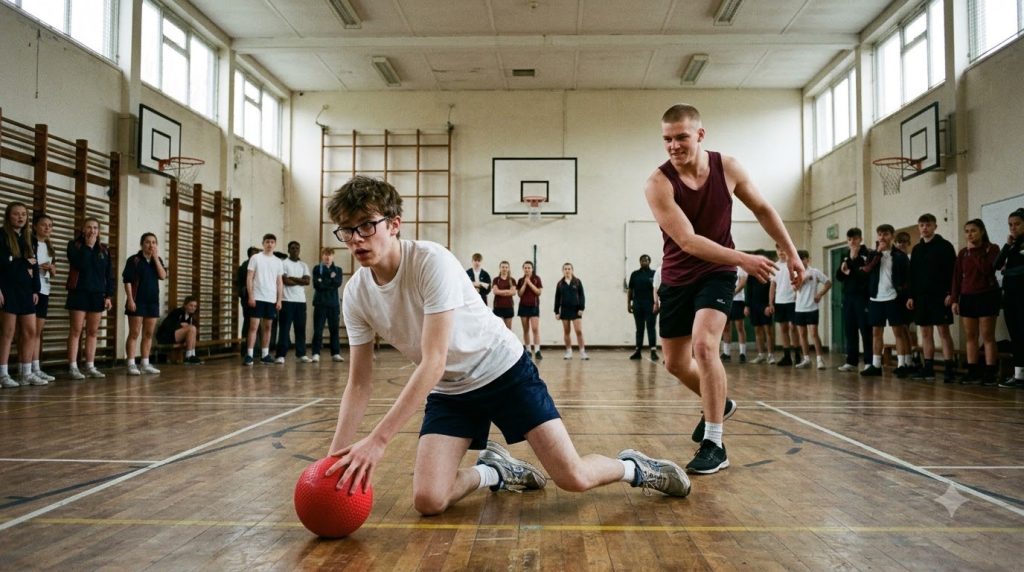
For me, that attention had begun early in the semester.
At first, it had been small.
A comment about my narrow shoulders.
A joke about my glasses.
A laugh when I struggled to catch a ball that had been thrown harder than necessary.
Then came the nickname.
Weak.
Sometimes he stretched the word until the boys around him laughed.
Sometimes he said it quietly when we passed each other.
Sometimes he simply looked at me, smiled, and shook his head, as though my existence had disappointed him.
I tried not to react.
I told myself that words only mattered if I allowed them to matter.
That was something adults often said, and it sounded reasonable when repeated in a calm room.
It was harder to believe when twenty people were watching someone make fun of you and waiting to see whether you would defend yourself.
Still, I kept my head down.
I did my exercises.
I followed the rules.
I stayed out of Bryce’s way whenever possible.
And every time I refused to answer one of his insults, he seemed to become more convinced that he had correctly understood me.
He believed I was weak.
Then, slowly, other people started treating me as though that belief were a fact.
It was not always obvious.
Sometimes it was the way someone looked away when Bryce called my name.
Advertisement
Hotel advertisement 2
Sometimes it was the hesitation before another student agreed to stand beside me during a team activity.
Sometimes it was the way a conversation stopped for half a second when I approached.
I did not imagine that everyone disliked me.
Most of the students in our class were ordinary people trying to get through their own days.
Some were kind.
Some were indifferent.
Some had laughed at Bryce once and probably regretted it later.
But indifference could be a powerful thing when it gathered around somebody who enjoyed humiliating others.
There were days when I could almost feel the space opening around me.
Not because people hated me.
Because they did not want Bryce to notice them standing too close.
I learned to recognize that space.
I learned where to leave my bag so nobody could knock it aside while pretending not to see it.
I learned to wait until the loudest group had gone through a doorway before following.
I learned that a quiet hallway could become uncomfortable if I heard Bryce laughing behind me.
And I learned the most exhausting lesson of all.
You could do everything possible to avoid a confrontation and still have someone determined to create one.
Gym class was supposed to be the easiest part of the school day.
That was how some of my classmates described it.
There were no essays to write, no difficult equations to solve, and no long passages to memorize.
We changed into athletic clothes, listened to instructions, completed whatever activity had been planned, and waited for the bell.
For students who enjoyed sports, it was a chance to move around.
For students who did not, it was supposed to be a manageable hour.
For me, it had become a place where I was never completely comfortable.
The gym itself was bright and spacious.
Basketball hoops hung at opposite ends.
Blue padding covered the lower walls.
The basketball court had clean painted lines that shone beneath the overhead lights.
When the room was empty, I liked it.
The steady hum of the ventilation system and the hollow echo of footsteps made it feel almost peaceful.
But during our class, the same acoustics turned every shouted nickname into something the entire room could hear.
Laughter seemed to travel farther there.
So did silence.
Our teacher usually kept the class organized.
He explained the rules, divided us into groups, and reminded everyone not to play too roughly.
He had a great deal to manage at once.
Twenty teenagers could make a surprising amount of noise even when they were behaving.
Balls bounced away.
Students argued about points.
Someone always needed water.
Someone else forgot where to return equipment.
I did not think our teacher was careless.
But Bryce had become very good at recognizing moments when an adult’s attention was somewhere else.
He rarely needed long.
A few seconds between activities could be enough for an insult.
A moment while teams changed sides could be enough for a deliberate shoulder bump.
Advertisement
Hotel advertisement 3
And if the teacher turned around afterward, Bryce usually looked as though he had been doing exactly what he was supposed to do.
I sometimes wondered whether the teacher understood how much happened between the moments he happened to see.
Then I wondered whether I should tell him.
That question was more complicated than it sounded.
I could imagine myself approaching him after class.