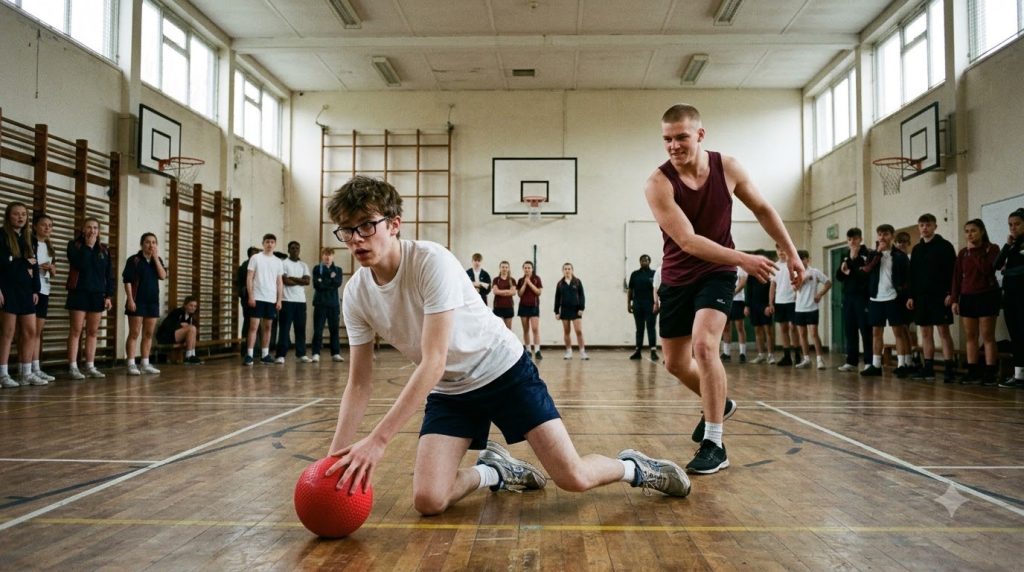
I could picture the empty gym, the rows of balls in their storage carts, the teacher standing with a clipboard.
I could even imagine the words.
Bryce keeps bothering me.
He won’t leave me alone.
But then I imagined the next class.
Bryce learning that I had complained.
His smile when he saw me.
The boys around him waiting to hear what he would say.
Perhaps the teacher would warn him.
Perhaps Bryce would behave for a day or two.
Then perhaps the comments would become quieter and more personal, the kind that adults never heard.
I did not know.
And because I did not know, I kept putting off the conversation.
I told myself that the semester would end.
I told myself that school was temporary.
I told myself that I could tolerate a few more weeks.
That reasoning helped me continue, but it did not make the situation better.
It only made my silence more predictable.
There was something else Bryce had misunderstood about me.
I did not believe that every disagreement needed to become physical.
That was not the same as believing I could never protect myself.
I had learned, partly through experience and partly through careful observation, that losing control in a confrontation usually made everything worse.
A person who was angry often expected the other person to become angry too.
If both people stopped thinking, even an ordinary argument could become dangerous.
So I had learned to pay attention to distance.
I noticed when someone stood too close.
I noticed where my feet were placed.
I noticed when another person’s movements changed from careless to deliberate.
And I knew that stepping away was not the same as surrendering.
Those were not skills I talked about.
They were not part of an identity I wanted people to admire.
I had no interest in proving that I was secretly tougher than anyone thought.
I only wanted to be able to protect myself if avoiding trouble stopped being an option.
Most of the time, avoiding trouble worked.
I could move away from someone who wanted an argument.
I could refuse to answer an insult.
I could let another student win a meaningless disagreement.
But every method depended on the other person allowing the encounter to end.
Bryce did not like letting things end.
If I ignored him, he followed with another comment.
If I stepped away, he called me scared.
If I declined a challenge, he announced that I had admitted defeat.
He seemed to believe that every interaction had to produce a winner and a loser.
And he was determined never to be the second one.
Advertisement
Hotel advertisement 4
I wondered whether he behaved that way because he enjoyed the attention or because he had become dependent on it.
I did not know him well enough to answer that question.
I only knew what happened when he looked across the gym and noticed me.
His expression would brighten.
He would say something loud enough for his friends to hear.
And suddenly I was no longer simply another student in class.
I was an opportunity.
The afternoon everything changed began as an ordinary gym period.
We had been playing dodgeball.
The rules were simple, and the teacher had explained them clearly.
The game would continue until the round ended.
Then we were supposed to stop throwing and put the equipment away.
No one was confused about that.
For most of the class, the game was lively but harmless.
Students ran between the painted lines.
Rubber balls bounced across the floor.
Sneakers squeaked as people changed direction.
A few students celebrated successful throws.
Others laughed when they missed easy catches.
I stayed near the edge of the court whenever I could.
I was not especially good at dodgeball, but I understood it well enough to participate.
I watched the balls.
I tried to keep enough distance from the strongest throwers.
I avoided unnecessary risks.
Most of all, I avoided looking directly at Bryce.
That had become almost instinctive.
He liked attention, and I had learned that making eye contact with him sometimes felt like issuing a challenge I had never intended.
Even so, I could hear him.
His voice carried across the gym as he called instructions to other players.
He celebrated loudly when somebody on the opposing side was eliminated.
When a ball slipped through another student’s hands, he laughed.
At one point, I heard him make another comment about somebody being weak.
I did not need to turn around to wonder whether he meant me.
There were enough students moving between us that I could concentrate on the game instead.
I remember the sound of the ball hitting the far wall.
I remember the teacher reminding us to stay within the boundaries.



